PULSED NONLINEAR SURFACE
ACOUSTIC WAVES IN CRYSTALS
R. E. Kumon, M. F. Hamilton,
Yu. A. Il'inskii, and E.
A. Zabolotskaya
Department of Mechanical Engineering
The University of Texas at
Austin
P. Hess
Institute of Physical Chemistry
University of Heidelberg
A. M. Lomonosov and V.
G. Mikhalevich
General Physics Institute
Russian Academy of Sciences,
Moscow
Paper 3aPAb6
16th International Congress
on Acoustics
135th Meeting of the Acoustical
Society of America
Seattle, Washington, USA
20-26 June 1998
J. Acoust. Soc. Am.
103, 2926(A) (1998)
ANISOTROPY IN CRYSTALLINE
SILICON
Stress-strain relation for cubic
crystal:
|
|
|
|
|
|
|
|
| 3
Second Order Elastic (SOE) constants |
|
|
|
|
| 6
Third Order Elastic (TOE) constants |
|
|
|
Data for Si elastic constants:
-
McSkimin, H. J. and Andreatch, Jr.,
P., J. Appl. Phys. 35,
3312-3319 (1964).
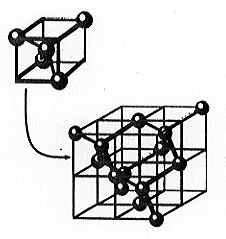
| Diamond Cubic Structure: |
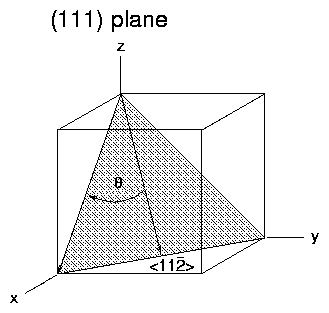
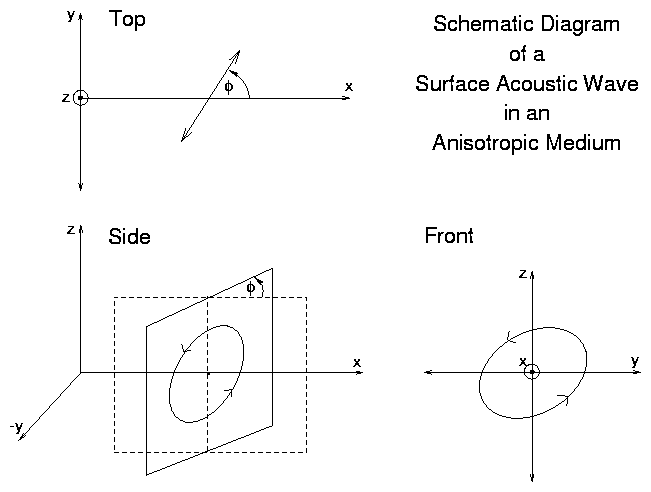
Crystal Cut in Experiment: |
 |
|
THEORY
| Approach: |
Hamiltonian mechanics formalism |
|
(Hamilton, Il'inskii, Zabolotskaya,
1996) |
Velocity waveforms in solid:
|
| vj(x,z,t)
= |
¥
å
n = -¥ |
vn(x)unj(z)ein(kx-wt) |
|
|
|
|
Coupled spectral evolution equations:
|
|
dvn
dx |
+an
vn = -n2 |
å
l+m = n |
|
lm
|lm| |
Rlmvlvm |
|
|
|
|
Solve equations numerically:
-
Input data
| |
Waveform spectrum |
(x = 5 mm) |
| |
Material constants |
(density, SOE, TOE) |
-
Apply 4th order Runge-Kutta
routine with:
| |
Number of harmonics: |
400 |
|
| |
Pulse repetition frequency: |
10 |
MHz |
| |
Maximum bandwidth: |
4000 |
MHz |
Weak absorption was added for
numerical stability.
EXPERIMENT
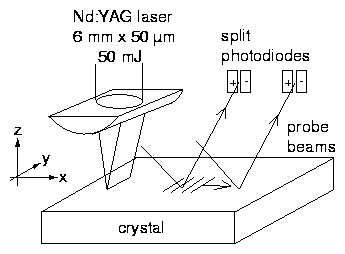
| Approach: |
Laser-excited thermoelastic
SAW generation |
|
(Lomonosov and Hess, 1996) |
- Pulse detection:
| Probe beam deflection proportional to
vertical velocity |
| Photodiode bandwidth: 500 MHz |
-
Beam locations:
| Laser excitation: |
x |
= |
0 mm |
| 1st probe beam: |
x |
= |
5 mm |
| 2nd probe beam: |
x |
= |
21 mm |
-
Resulting SAW pulses:
| Duration: |
20 to 40 ns |
| Peak strain: |
0.005 to 0.010 (near fracture) |
DIFFRACTION EFFECTS
Measured frequency spectrum
at x = 5 mm:
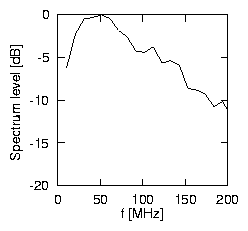
Characteristic frequency:
50 MHz
-
Analysis:
| Characteristic beam radius: |
a |
= |
3 mm |
| Diffraction length for SAW
beam: |
[1/2]ka2 |
= |
300 mm |
| Furthest measurement distance: |
x |
= |
21 mm |
-
Conclusion:
Diffraction effects are
not important.
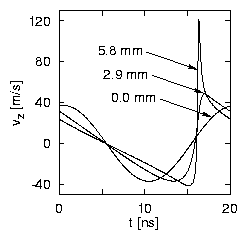
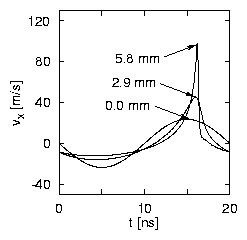
SIMULATIONS WITH
SINUSOIDS
Calculated vertical velocity
waveforms:
 Calculated longitudinal velocity
waveforms:
Calculated longitudinal velocity
waveforms:
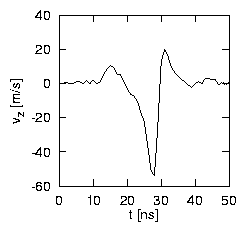
WAVEFORMS AT FIRST
LOCATION
Measured vertical velocity
waveform at x = 5 mm:
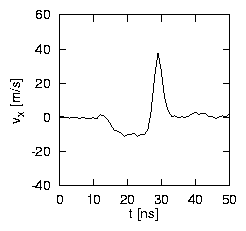
 Calculated longitudinal velocity
waveform from linear theory:
Calculated longitudinal velocity
waveform from linear theory:
EVOLUTION OF WAVEFORMS
Velocity waveforms at x
= 5 mm:
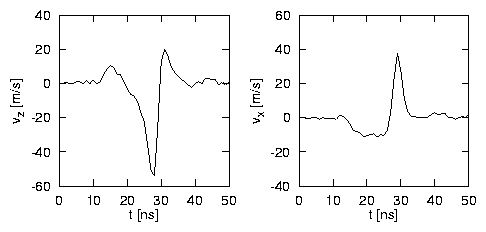
Velocity
waveforms at x = 21 mm:
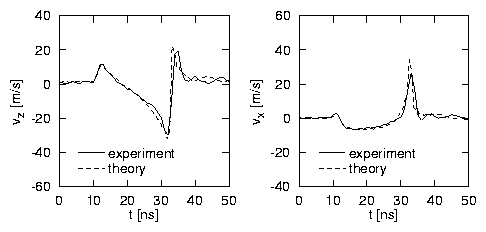
EFFECT OF RECONSTRUCTION
BANDWIDTH
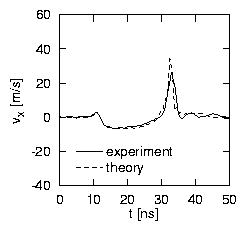
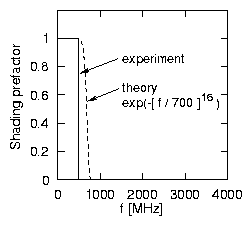
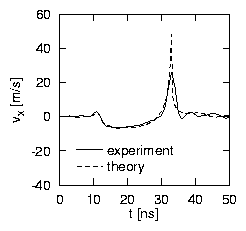
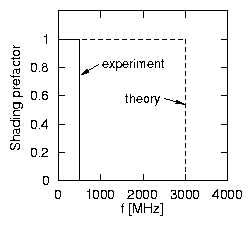
Consider the longitudinal velocity waveforms at x = 21 mm.
Theoretical waveforms with
shaded bandwidth of 700 MHz:
Theoretical waveforms with
bandwidth of 3000 MHz:
CONCLUSION &
FUTURE WORK
Results:
-
First reported comparison of
experiment and theory for nonlinear SAW in a crystal
-
Theory in close quantitative
agreement with experiment
-
Predictions based on fundamental
material properties
Future work:
-
Study relationship between nonlinearity
matrix elements and waveform distortion
[Norfolk ASA meeting]
-
Study variation of waveform
evolution as function of direction and cut
-
Investigate other anisotropic
materials
-
Investigate piezoelectric effects
File translated from TEX by
TTH,
version 0.99 with some minor editing by Ronald Kumon.