Virtual Presentation Instructions:
- Each ``slide'' of the presentation is demarcated by
horizontal rules. The title of each slide is a hyperlink to
the corresponding section of slide ``notes'' contained within
this document.
- Browsers that support frames will show the
outline of the presentation in a green side bar. The hyperlinks in
the outline will move the user directed to the
slides and slide notes named by the hyperlink. The slides will
be displayed in the top left frame and the slide notes in the
bottom left frame.
- The major points listed in each section of the slide
notes describe the major heading on each slide.
Supplementary information about each slide is listed in
subpoints. A supplementary discussions about the
nonlinearity matrix and linear theory is
given at the end of this document.
- These pages require a browser that supports HTML 3.2+
(Netscape 3.0+, Internet Explorer 3.0+). If you do not see the
Greek letter xi here, x, then your browser may not be
configured to use the ``Symbol'' fonts and you will not be able
to properly read the formulas in the presentation. For information on
how to do this for your platform, please see the
TTH web site.
|
SLIDE NOTES
Notes on COVER PAGE
- The experimental work was supported by Volkswagen-Stiftung,
Deutche Forschungsgemeinschaft, and the Russian Foundation for
Basic Research.
- The theoretical work was supported by the U.S. Office of Naval
Research.
- Yu. A. Il'inskii and E. A. Zabolotskaya are now employed by
MacroSonix Corporation, Richmond, Virginia, USA.
Notes on ANISOTROPY IN CRYSTALLINE SILICON
- This talk will focus on surface acoustic waves (SAW)
in crystalline silicon. Crystalline silicon is a cubic
crystal (see ``Diamond Cubic Structure'' diagram).
Cubic crystals have the stress-strain relation shown in the
slide. Usually the strains are sufficient small that the
linear relation sij = cijklekl is valid.
However, the strains considered here are
large enough that the nonlinear terms contribute
significantly and, in fact, give rise to shock formation.
-
Diamond Cubic Structure:
Si has a diamond lattice which can also be considered to
be two fcc lattices, one displaced relative to the other
by \mathsf(1/4, 1/4, 1/4).
Note also that every atom has four nearest
neighbors. The lattice spacing for Si is 0.543 nm.
- The material properties of the crystal are expressed via
the elastic constants of the material. In particular,
3 SOE and 6 TOE constants are necessary to specify a cubic
crystal. For all the simulations presented in this talk,
the data for the Si elastic constants was taken from
the paper by H. J. McSkimin and P. Andreatch, Jr.,
J. Appl. Phys. 35, 3312-3319 (1964).
- Because these systems are anisotropic, the wave propagation
is different depending on how the crystal is cut and the
direction that the wave is travelling.
- The surfaces of cut crystals have traditionally
been described using a crystallographic convention called
Miller indices. Miller indices are defined by finding
three noncollinear atoms on the surface that intersect the
crystal axes and then applying the following method:
- Find the intercepts of the three basis axes in terms of
the lattice constants.
- Take the reciprocals of these numbers and reduce to the
smallest three integers having the same ratio. The
result is enclosed in parentheses \mathsf(hkl).
[from C. Kittel, Introduction to Solid State
Physics, 2nd ed. (John Wiley & Sons, New York, 1965), p. 34]
Note that if the Miller indices are interpreted as a vector
components, the resulting vector is normal to the surface of the
cut.
- Directions are specified in a different way:
The indices of a direction in a crystal are expressed as the
set of the smallest integers which have the same ratios as the
components of a vector in the desired direction referred to the
axis vectors. The integers are written in square brackets,
\mathsf[uvw].
The \mathsfx axis is the \mathsf[100] direction;
the \mathsf-y axis is
the \mathsf[0[`1]0] direction. A full set of equivalent
directions is denoted this way: \mathsfáuvw ñ.
[from C. Kittel, Introduction to Solid State
Physics, 2nd ed. (John Wiley & Sons, New York, 1965), p. 34]
This presentation will use both of these notations frequently.
- The crystal cut chosen in the experiment is the (111) plane
(see diagram). For the experiment and simulations shown in
this talk, the pulses propagated in the
á112ñ direction.
Notes on SCHEMATIC DIAGRAM: SURFACE ACOUSTIC WAVE
- This figure shows the particle motion of a typical
surface acoustic wave in an anisotropic medium.
Consider the case of a surface acoustic wave with an
initially sinusoidal velocity waveform in an isotropic
and anisotropic material. Assume that the x-axis
is in the propagation direction and that the z-axis is
normal to the surface cut.
- In the most general case, the particle motion is
elliptical with the plane of the ellipse rotated by some angle
f out of the xz-plane. Different perspectives of this transverse
motion are shown in the top and front views.
- Due to the symmetry of the particular cut and direction
considered here, f = 0. Hence there is no transverse
component to the particle motion. Note, however, that further
investigation has shown that transverse motion does occur for other
directions in the same plane. This situation differs from
the isotropic case in that transverse motion does not exist
for waves propagating in any direction.
Notes on THEORY
- Briefly, the approach used here involves calculating
the Hamiltonian energy function through cubic order in
the wave variables, choosing appropriate generalized
coordinates, applying the equations of motion in canonical
form, and deriving evolution equations for the slowly varying
amplitudes in a suitable retarded time frame. The approach was
outlined in M. F. Hamilton, Yu. A. Il'inskii,
and E. A. Zabolotskaya, ``Nonlinear surface wave propagation
in crystals,'' Nonlinear Acoustics in Perspective,
R. J. Wei, ed. (Nanjing University Press, Nanjing, China, 1996),
pp. 64-69.
- Note that computing the Hamiltonian the quadratic
order would only give rise to linear terms in the model
equations. Thus, the potential
energy terms to at least cubic order in the strain must
be included to model nonlinear effects.
- Note also that this method is very general.
It is applicable to any elastic
material for which the SOE and TOE constants are known
and to any cut and direction in such a material.
- Assumptions:
- It is assumed that the nonlinear solution is close
to the linear solution; in particular the depth
dependence of each frequency is the same as in the
linear solution.
- It is assumed that the wave fronts are planar.
- It is assumed that the wave is progressive, i.e.,
travels only in one direction. (It should be
possible to extend the theory to include compound waves;
only the results will be more complicated.)
- The velocity waveforms in the solid
are assumed to take the form shown in the slide.
- The coordinate system for the solution is chosen such that the
the z-axis is perpendicular to the surface of the solid and
the x-axis is in the direction of the propagation of the wave.
- Note that on the surface they simplify to
|
vi(x,z,t) = |
¥
å
n = -¥
|
vn(x) |
3
å
s = 1
|
b(s)i eint [ v*n = v-n] |
|
where t = k0x-w0t is the retarded time
and the bi(s) are constants determined from the linear
problem.
- Note that surface acoustic waves are non-dispersive, i.e.,
their wave speed is not frequency dependent.
- The coupled, nonlinear spectral evolution equations
that result from this approach are shown above.
Here vn is the complex amplitude of the nth harmonic,
an is the attenuation coefficient for the nth harmonic,
and Rlm is the nonlinearity matrix.
- The ad hoc attenuation term an = n2a1
is added to the left-hand side for purposes of numerical
stability when solving the equations. For all the cases
shown here the dimensionless value of a1 = 0.025.
This attenuation is sufficiently weak that its main effect
is to stabilize the portion of the waveform in the neighborhood
of the shock without significantly the remainder of the
waveform. Note that the dimensionless value of a1 here
is the analog of the Goldberg number G for nonlinear
acoustic waves in fluids.
- Physically, the nonlinearity coefficients Rmn
represent the strength of the coupling between different
harmonics in the wave. They are given by a complicated
analytical expression which can be determined completely
by knowing the SOE and TOE constants of the material.
(See the supplementary notes below for the equation for Rmn and
more information.)
- For the case of isotropic materials,
these equations can be shown to reduce to the evolution
equations previously derived by Zabolotskaya
[E. A. Zabolotskaya, ``Nonlinear propagation of plane and
circular waves in isotropic solids,''
J. Acoust. Soc. Am. 91, 2569-2575 (1992)].
- While Hamilton's equations describe the evolution of a system in
time, the evolution equations listed in the slide
evolve in space, not time. Informally speaking, the
transformation between the two is done by moving into
retarded time frame and thereby replacing
¶/¶t with c ¶/¶x.
It is possible to demonstrate formally that this is the
proper transformation and that it is not an approximation
[E. Yu. Knight, M. F. Hamilton, Yu. A. Il'inskii, and
E. A. Zabolotskaya, ``General theory for the spectral evolution
of nonlinear Rayleigh waves,'' J. Acoust. Soc. Am.,
102, 1402-1417 (1997)].
- The spectral evolution equations were solved numerically.
First the nonlinearity matrix elelments
Rlm were computed from the material constants, and
the spectral ``source'' condition was computed from the
data measured at x = 5 mm from the excitation point (see diagram
on the ``Experiment'' slide for the experimental setup).
Next, a fourth-order Runge-Kutta routine was used to
integrate the system. The waveform expansions used had
400 harmonics. With a pulse repetition frequency of 10 MHz,
the bandwidth realizable by the simulations was then 4000 MHz.
- In theory, there are an infinite number of
equations to integrate. For purposes of computation, the
velocity waveform expansions were truncated such that only terms
with n = -400 to n = 400 were included in the sum.
However, because the velocity waveforms must be
real-valued, v-n = v*n. Therefore only 400 spectral
amplitudes must be determined and, correspondingly,
only 400 equations must be integrated.
- Strictly speaking, the Fourier series expansion of a
function can only be done if the function is periodic.
To allow the pulse to be
modelled with a relatively small number of harmonics, it is
necessary then to assume that the ``pulse'' is not a single
event but one in a series that repeats periodically. For these
simulations, the pulsed signal was assumed to repeat every 100 ns,
thereby giving a pulse repetition frequency of 10 MHz. This
is then the lowest frequency component that can be modelled by
the simulation. With 400 harmonics, this also makes 4000 MHz
the highest frequency that can be modelled.
Notes on EXPERIMENT
- The approach used here generates SAW via thermoelastic
laser excitation. This method was described previously
by A. Lomonosov and P. Hess, ``Laser excitation and
propagation of nonlinear surface acoustic wave pulses,''
Nonlinear Acoustics in Perspective,
R. J. Wei, ed., (Nanjing University Press, Nanjing, China,
1996), pp. 106-111.
- The basic setup is shown in the diagram. The SAW pulse was
generated by a Nd:YAG laser that was focused with a cylindrical
lens into a thin strip 6 mm by 50 mm on the surface of
crystal. To detect the resulting SAW pulse, optical probe beams
were employed. This can be done because probe beam deflection
is proportional to the vertical velocity component vz at the
surface. The probe beam deflections were detected by split
photodiodes with a bandwidth of 500 MHz. The probe beams
irradiated spots approximately 4 mm in diameter on the
surface at distances 5 mm and 21 mm from the excitation region.
- Experimental details:
The Nd:YAG laser that generated the surface waves had a
wavelength of 1064 nm (infrared), pulse duration 7 ns, and energy
up to 50 mJ. A strongly absorbing carbon layer in the form of
an aqueous suspension was placed on the surface
of the Si in the excitation region to facilitate energy transfer
to the surface and prevent cracking. The transient SAW
waveforms were then measured absolutely with a calibrated
probe-beam deflection setup using stabilized cw Nd:YAG laser
probe beams with a wavelength of 532 nm (green visible)
and power of 40 mW.
- Surface wave pulses in these experiments had durations of
20-40 ns and peak strains between 0.005 and 0.010. As will be
shown below, pulses of this magnitude exhibit nonlinear behavior
that give rise to waveform distortion and shock formation.
- For example, a previous experiment (described in the
Lomonosov and Hess reference above) generated SAW in Si with
particle velocities of over 40 m/s. Because the surface
acoustic wave speed for silicon in this direction is 4730 m/s,
the Mach number equals 0.0085. To compare, the equivalent Mach
number in air at room temperature is equivalent to a SPL of
155 dB (re 20 mPa). The same experiment generated
peak-to-peak particle displacements of over 700 nm. Because the
lattice constant for Si is only 0.543 nm, this means that the
displacement is nearly 1300 times the size of the atoms in the
crystal.
- In fact, the strains are so large that in some cases the pulses
generated caused the Si crystal to fracture. The optical
absorptive liquid placed on the surface (described above)
helps to prevent this from occurring.
Notes on DIFFRACTION EFFECTS
- Because the theory presented above models only plane waves,
it is necessary
to determine if the effects of diffraction are significant
in the SAW beam that is produced by the experiment.
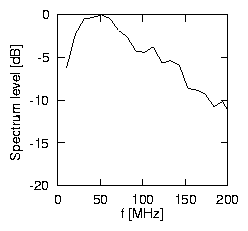
- To do this, first examine the measured frequency spectrum
shown in the diagram at the ``source'' probe location of x = 5 mm.
The peak in the spectrum occurs around 50 MHz.
- With this information, the effects of diffraction can be estimated
by computing the diffraction length of the beam.
With a characteristic beam radius of 3 mm and the
characteristic frequency of 50 MHz, the diffraction
length for the SAW beam is computed to be around 300 mm.
However, the furthest
measurement distance here is only 21 mm, a full order of
magnitude less than the diffraction length.
- The diffraction length, as known as the Rayleigh distance,
is the approximate distance past which the
wavefronts in the beam are no longer essentially planar.
It marks the transition between the near-field and far-field
regions of the beam. For more information on nonlinear
sound beams, see M. F. Hamilton, ``Sound beams,'' Chap. 8 in
Nonlinear Acoustics, M. F. Hamilton and
D. T. Blackstock,, eds. (Academic Press, Boston, 1998),
pp. 233-261.
- The conclusion here is then that diffraction effects are not
important, and the theoretical predictions should be valid in
this regime.
Notes on SIMULATIONS OF SINUSOIDS
- This slide shows simulations performed with a monofrequency,
continuous wave, sinusoidal signal as the source condition (x =
0 mm) at several distances. As shown here, the vertical
velocity is a cosine wave while the longitudinal velocity is a
sine wave.
- The top diagram contains the longitudinal
velocity waveform while the bottom figure contains the
vertical velocity waveform. Due to the symmetry of
this particular case, there is no transverse velocity
component. The longitudinal velocity is computed
from vertical velocity by linear theory. The waveforms
were reconstructed with a bandwidth of 4000 MHz to match the
maximum bandwidth of the numerical simulations.
- The period of the wave was taken to be 20 ns so that the
characteristic frequency is 50 MHz as in the pulse data.
In addition, the amplitude of the vertical velocity
component was selected to be 37 m/s, close to the
characteristic velocity (half the peak-to-peak velocity)
of the pulse data.
- From these characteristic values, an estimate of the
shock formation distance can then be computed from theory
to be around 2.9 mm. Because the pulse propagation
distance Dx = 16 mm, the pulse is well into the
shock formation region.
- The estimate of the shock formation distance is
computed via a quasilinear analysis of the harmonic generation.
See D. J. Shull, M. F. Hamilton, Yu. A. Il'insky, and
E. A .Zabolotskaya, ``Harmonic generation in plane and
cylindrical nonlinear Rayleigh waves,''
J. Acoust. Soc. Am. 94, 418-427 (1993)
for an example of how this is done for isotropic materials.
- Notice also that the waveform distortion is asymmetric
and the peaks increase significantly in magnitude.
Going forward in time from the trough to the peak, the
vertical velocity waveform steepens, while going
from the peak to trough, the waveform flattens.
In the longitudinal velocity waveform, the peaks recede
in time while the troughs advance in time.
This behavior, which is opposite
to the distortion of a sound wave in a fluid, occurs because
the coefficient of nonlinearity is negative in this case.
Similar distortions will be seen in the pulse data.
- The cusped peaks increase in magnitude because as the waveform
distorts more of its energy is shifted into higher frequency
components. Because the penetration depth of a SAW is
proportional to its wavelength, these higher frequency
and lower wavelength SAW have more of their energy near
the surface. It is this effect that causes the large peaks.
Corresponding snapshots of the SAW further beneath the surface would
show that the peaks of the waveforms at those depths
would decrease in magnitude so that energy is conserved.
Notes on WAVEFORMS AT FIRST LOCATION
- This slide shows the experimental data at the first probe
beam location (x = 5 mm).
- Notice that the vertical velocity waveform has the
general trends of the cosine signal shown in the
vertical velocity waveform on the previous slide.
Hence it may be expected that the portion of the waveform
going forward in time from the trough to the peak will
steepen, while the portion going from the peak to the
trough will flatten.
- Similarly, the latter part of the longitudinal
velocity waveform has the general trend of the sine signal
shown in the previous slide. Hence it may be expected
that the larger peak will recede and the trough will advance.
The smaller peak will also recede but less than
the larger peak. The net result will be that the
the pulse will lengthen in time.
Notes on EVOLUTION OF WAVEFORMS
- This slide shows the evolution of the experimental waveforms
from the first probe beam location (x = 5 mm) to the
second probe beam location (x = 21 mm).
The experimental (solid line) and theoretical (dashed line)
waveforms are also compared at the second beam location.
- The comparison shows that the theory is in close quantitative
agreement with the experiment, and the waveforms evolve
generally as expected based upon the discussion of the
sinusoidal waveform simulations above. Here the experimental
waveforms have a bandwidth of 500 MHz (from the photodiodes)
while the theoretical waveforms were reconstructed with
bandwidth of 700 MHz. Note the distinct lengthening
of the pulse as seen most clearly by comparing the longitudinal
velocity waveforms (it can also be seen in the supplementary
notes below).
- One aspect of the waveforms that does not seem to match
the sinusoidal simulations is that the pulse height does
not increase significantly. As will be shown next, this
is probably due to the fact that the bandwidth limitations
of the photodiodes exclude the higher frequency terms
necessary to record steep shocks and narrow peaks. In other
words, the temporal resolution of the experiment (1 ns)
is probably insufficient to resolve the very short peaks
in the evolved waveforms.
Notes on EFFECT OF RECONSTRUCTION BANDWIDTH
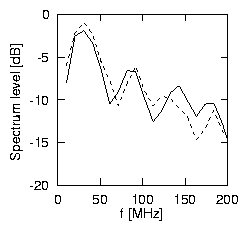
- This slide shows the experimental data for the longitudinal
velocity at the second probe location (x = 21 mm) along with
two theoretical waveforms reconstructed with different
bandwidths. In both of the theoretical waveforms, the
spectral amplitudes were computed out to 4000 MHz, but
the amplitudes where weighted by the shading function shown
in the diagrams on the right side of the page.
- While it is possible to reconstruct
the waveforms with all 4000 MHz
of spectral data, this actually gives less accurate
results because the highest frequencies contain the energy
aliased from all even higher frequencies. This is purely
a numerical effect that arises from truncating the
frequency spectrum at a finite value.
- The top set of figures shows the theoretical waveform
reconstructed with 700 MHz of shaded spectral data.
In other words, each spectral amplitude was multiplied by
the weighting function exp(-[f/700]) before reconstruction
in the time domain (here f is the frequency of
the spectral amplitude) .
The frequency content of the resulting theoretical waveform
is then close to the frequency content of the experimental
waveform (500 MHz), and the peak height matches closely.
- The bottom set of figures shows the theoretical waveform
reconstructed with 3000 MHz of the spectral data.
Because the frequency content of the resulting theoretical waveform
is significantly greater than the frequency content
of the experimental waveform (500 MHz), the
theoretical waveform can then resolve sharper peaks.
These large peaks then parallel the large peaks
seen above in the sinusoidal simulations.
- Hence it appears likely that if the bandwidth of the photodiodes
of the experiment were larger, then sharper peaks would be observed.
Notes on CONCLUSION & FUTURE WORK
- To conclude, this is the first reported comparison of experiment
and theory for nonlinear SAW in a crystal. The theory is in
close quantitative agreement with the experiment and the
predictions of the theory are based on the fundamental
properties of the material (density, SOE, TOE).
- Future work will include studying the relationship between
the nonlinearity matrix elements and waveform distortion
(to be discussed at the Norfolk ASA meeting), studying the
variation of waveform evolution as function of cut and
direction, investigating other anisotropic materials, and
investigating piezoelectric effects.
Supplement: NONLINEARITY MATRIX & LINEAR THEORY
The nonlinearity matrix is given by